
PocketMagic

PocketMagic

Where Technology meets magic


Android
45 Posts
BlackBerry
4 Posts
Electronics
68 Posts
Hardware
120 Posts
High Voltage
49 Posts
iPhone
4 Posts
Linux
2 Posts
Nuclear
20 Posts
Optics
11 Posts
Photography
7 Posts
Photoshop
3 Posts
Research
19 Posts
Reviews
18 Posts
Robotics
8 Posts
Security
7 Posts
Software
73 Posts
Symbian
2 Posts
Tubes
18 Posts
Windows
3 Posts
Windows Mobile
11 Posts

Top Articles!       See PocketMagic on Facebook


uRADMonitor - Online Radiation monitoring station | 14873 Views | Rate 70.16
uRADMonitor - Online Radiation monitoring station
Bluetooth and iOS - Use Bluetooth in your iPhone apps | 17952 Views | Rate 58.1
Bluetooth and iOS - Use Bluetooth in your iPhone apps
NMEA GPS Library for AVR Microcontrollers | 4799 Views | Rate 56.46
NMEA GPS Library for AVR Microcontrollers
Programmatically Injecting Events on Android - Part 2 | 4948 Views | Rate 44.58
Programmatically Injecting Events on Android - Part 2
Building a robot – Part 2 | 4575 Views | Rate 44.42
Building a robot – Part 2
Simple Switched power Supplies | 16034 Views | Rate 41.65
Simple Switched power Supplies
Capacitor Discharge Microspot Welder / Cutter | 11270 Views | Rate 36.35
Capacitor Discharge Microspot Welder / Cutter
Developing for Blackberry 10 | 71 Views | Rate 35.5
Developing for Blackberry 10


Ion thruster using 50KV Supply


By Radu Motisan Posted on December 1st, 2010 , 2490 Views (Rate 2.76)


It is possible to get thrust by producing and accelerating ions using a very high voltage supply
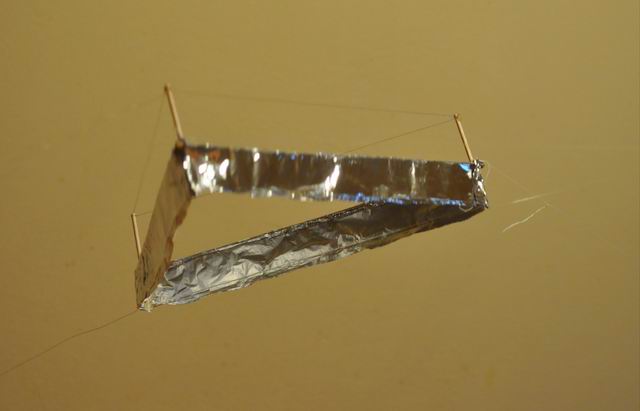
The trust is small, but it is enough to lift the small triangle construction. On the other hand this type of 'motor' can produce a great impulse, meaning a vehicle using this kind of propulsion can achieve great speeds.

Notes:
This video is what my camera recorded, with no afterward processing. The hissing sound is caused by the High voltage.
The pieces of paper are to demonstrate the vertical flow of air and ions produced by the motor. When the setup is hovering above, you will see them move.
The power supply (and the energy requirements) are too big for the trust this setup can produce. So because of this, I cannot build an autonomous device, and the supply must be external. There are two thin wires going from the 50kv supply to the Ion Thruster.
The movement is erratic, a flying object using this technology would need to use additional stabilizers to follow a given trajectory. For this demo I used two thin thread anchors and the supply thin wires. Even so, the movement is unpredictable, but it proves the Ion Thruster works.


More on PocketMagic:

Programmatically Injecting Events on Android - Part 1 | 10141 Views | Rate 26.2
Programmatically Injecting Events on Android - Part 1
Atmega8 and enc28J60 for ethernet support | 7203 Views | Rate 24.42
Atmega8 and enc28J60 for ethernet support
How to set the AVR Fusebits | 1689 Views | Rate 23.79
How to set the AVR Fusebits
ATMega128 and HD44780 LCD using 3 Wires with the 74HC164 | 2035 Views | Rate 22.87
ATMega128 and HD44780 LCD using 3 Wires with the 74HC164
CDV-742 Dosimeter and CDV-750 Dosimeter Charger | 109 Views | Rate 21.8
CDV-742 Dosimeter and CDV-750 Dosimeter Charger
Dual H-Bridge for controlling two motors | 1185 Views | Rate 21.55
Dual H-Bridge for controlling two motors

4 Responses to “Ion thruster using 50KV Supply”

  1. 1
    Joseph R. Gallo:

    According to Sub-Quantum Kinetics, this is most likely an Electro-Gravitic Propulsion device, not a “ionic” propulsion device, as “civilian” Relativist physicist (unlike military R&D physicists) would prefer to call it.

    I would suggest a good read: “Secrets of Antigravity Propulsion” by Paul A. LaViolette, Ph.D.

    I would really appreciate your plans to build this device for myself, although I think I have a good idea how to do it.

  2. 2
    Radu Motisan:

    Hello Joseph,

    Thanks for your message, however in my opinion there are ions that give this device thrust. I do not believe Electro-Gravitic propulsion devices are currently possible.

    Regarding your question, I do not have any other recorded information, besides what’s presented on this page. I should underline that the construction itself should be very light-weighted and the bottom electrode (aluminum foil) should be as big as possible (in terms of surface).

  3. 3
    William Eckhardt:

    Try an HID power supply an the air gap between foil and thin wire should be 1 cm per thousand volts.

  4. 4
    Radu Motisan:

    Will, can you elaborate on that?

Thank you for commenting. Your comment won't show until approved, which can take some time.

Please copy the string yuXr1P to the field below: