
I needed a fast digital counter so I built one using 6 CD4026 ICs and 6 seven digit displays for a 0..999,999 display.
Here is a test video showing the counter at work, first at 200 impulses per second, then at 30000 impulses for second (30KHz). For signal generator I used a simple 555 circuit. To change the frequency to 30KHz I removed a higher capacity capacitor, leaving a smaller rated one.
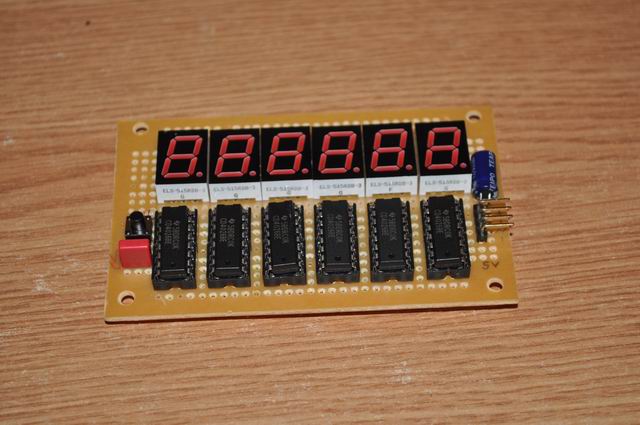
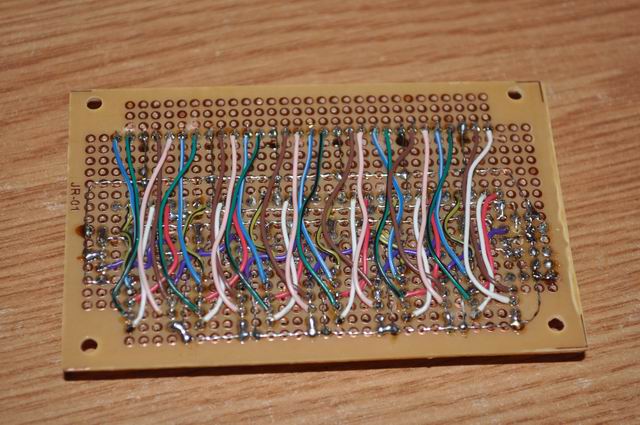
A few pictures with the circuit itself:

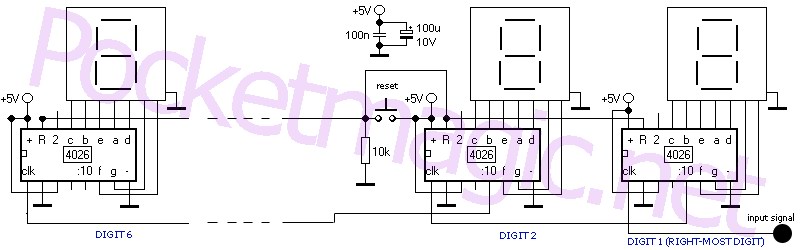
The schematics I used (very straight forward):
Salut,
Crezi ca s-ar putea adapta un afisor VFD la acest proiect?
Ar arata cu siguranta mult mai interesant si ar da o noua utilizare vechilor VFD-uri…
CD4026-le e bun ca numarator in baza 10, si pentru legatura cu urmatorul CD4026 (incrementarea unitatii urmatoare), are conexiuni directe pentru a,b,c,d,e,f,g-ul afisajului cu 7 segmente. Cu alte cuvinte CD4026 produce toate combinatiile necesare afisajului cu 7 segmente pentru a desena cifrele suportate.
Deci sigur partea de numarator in baza 10 s-ar putea folosi in scopul propus de tine, in schimb nu stiu ce interfata necesita un VFD pentru a desena cifrele.
Am verificat VFD-ul, e ceva destul de complex de comandat, are 9 digiti, toate segmentele sunt legate in paralel si fiecare anod are conexiune separata, deci intr-un cuvand multiplexare la greu
Cred ca numai un uC l-ar putea comanda sau un circuit spectial
dar tot asa e si afisajul cu 7 segmente care l-am folosit!
Vezi datasheetul pentru ELS-515 postat aici:
http://www.pocketmagic.net/wp-content/uploads/2011/12/els-515.pdf
La acest afisaj , catodul (ledurilor) e comun.
Pune o poza cu VFD-ul tau
In postul anterior an facut o greseala grilele pentru fiecare segment au conexiune separata
Ideea e ca nu prea vad cum ar putea fi folosit in proiectul prezentat de tine.
Uite aici o poza cu afisorul meu, nu prea reusita dar se intelege…
http://postimage.org/image/4ixzx0k3f/
Frumos afisaj, merita sa il faci functional. 19 Pini si 9 cifre? Ce model e, ai gasit vreo informatie despre el?
Da, 19 pini si 9 cifre
E Futaba, pe o eticheta de pe spate scrie 9-ST-11 si dedesupt 8F(ștampilat) dar pe el e marcat totusi 9-ST-10
Nu am gasit nimic pe internet despre el din pacate…
Ar fi interesant de facut un frecvențmetru cu el, de buzunar, cu ceva uC SMD, dat fiind si dimensiunea lui mica(fix cat 3 monede de 10 bani una langa alta) ce ma duce cu gandul ca a functionat intr-un calculator de buzunar
Mai in josul link-ului urmator este un display aproape identic cu al meu.
http://www.vintagecalculators.com/html/calculator_displays.html
Mai am inca unul, mai mic, sub forma de lampa, tot cu 19 pini si 9 cifre, acela e si mai interesant
E aproape identic cu cel de mai jos, cu exceptia pinilor care sunt toti dispusi intr-un capat
http://ferretronix.com/tech/vfd/lloyds_vfd_calculator_60.jpg
Good night. have on hand the electronic diagram of the NE555 oscillator 200 to 30000 pulses per second? thanks
@mijael: here is an example: http://www.pocketmagic.net/wp-content/uploads/2009/07/555.jpg
you don’t need the IRFP640, nor the flyback transformer, collect the signal after the totem pole (after the two PNP+NPN transistors ).
thanks
I just saw the picture attached, I simulated livewire, as I can do to send the reference image I have simulated? an email?
You can upload it to tinypic.com and post it as comment
http://tinypic.com/view.php?pic=2qs5mk4&s=6
Radu, am o intrebare: daca vreau sa fac un numarator cu 4 afisaje, in loc de 6, cum ar trebui sa continui dupa al doilea integrat din dreapta? Exact ca blocul 2, dar fara butonul de reset? O schema mai explicita m-ar ajuta daca ai. 🙂
Salut Cosmin,
E mai simplu decat pare, dar din pacate nu am o alta schema, numai daca nu desenez una repede de mana, dar cu atatea conexiuni ar arata cam rau.
Trebuie sa faci in felul urmator:
– pornesti cu 4026-ul pt cea mai din dreapta cifra, sa il numim CI1
– pinul :10 al lui CI1, trebuie sa mearga la pinul CLK al lui CI2
– pinul :10 al lui CI2, la pinul CLK al lui CI3
– si in fine, pinul L10 al lui CI3 , merge la pinul CLK al lui CI4
In acest fel, cand CI1 ajunge la 10, incrementeaza CI2. Valabil pt restul.
Pentru RESET, toate CI-urile trebuiesc sa poata fi resetate. Trebuie sa pui un intrerupator care cand e apasat , trimite 5V catre pinii de RESET ai celor 4 4026.
Semnalul il introduci prin pinul CLK al CI1. Dupa cum vezi, primirea unui puls pe CLK produce incrementare.
Da-mi de stire daca ai si alte intrebari.
This schematic is copy from http://danyk.cz/dig_poc.html