
Pictures:
Details:
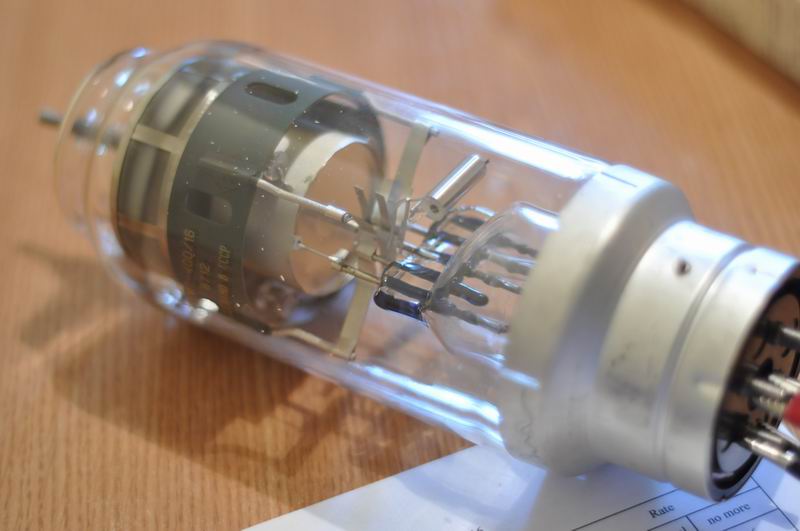
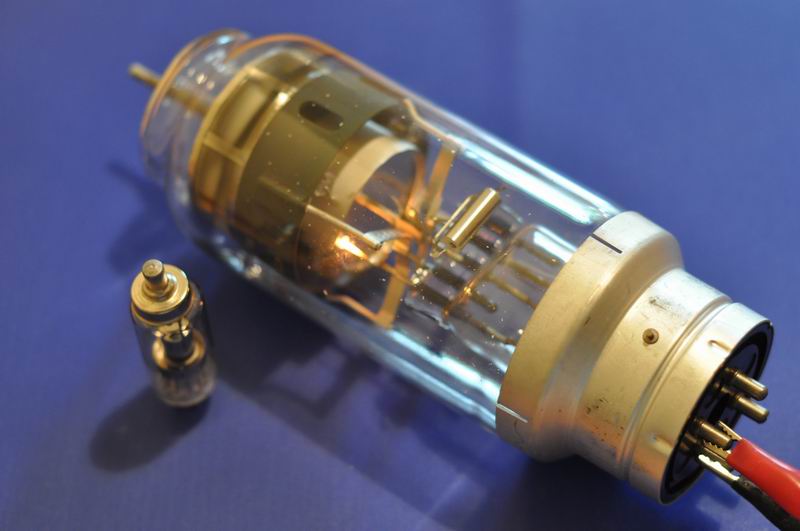
I’ve already presented a few words on Thyratrons in one of my previous articles on this topic. Now I want to show you a new addition to my collection, a hydrogen thyratron tube!
These tubes are a rare find, and when you do find them, they are usually expensive.
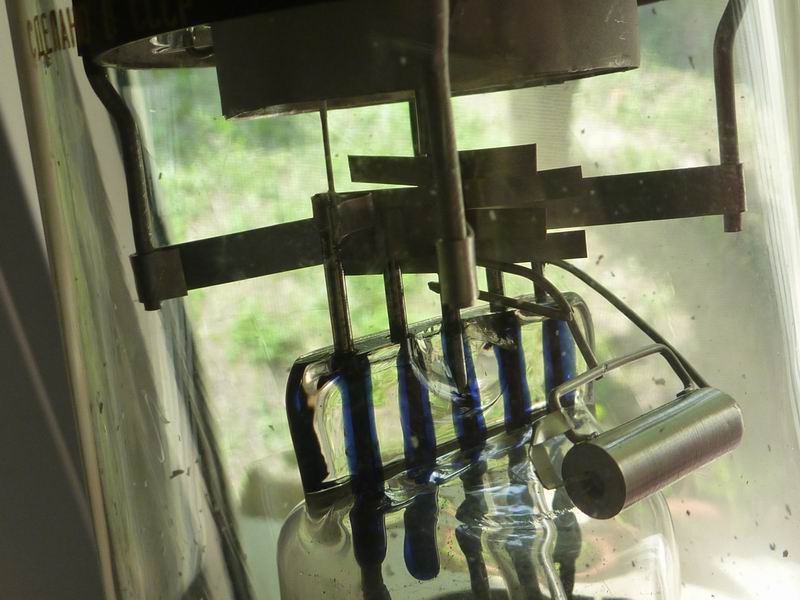
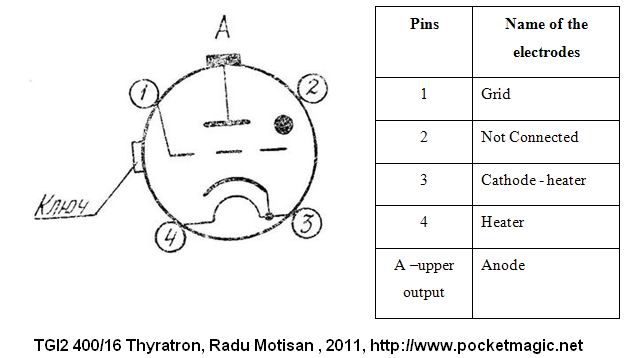
The tube consists of a cathode, a filament, a grid, the anode and a hydrogen reservoir equiped with a secondary filament. This secondary filament is connected to the main filament using a coil, to limit the current. Everything is built in, so you only need to power the first filament. It uses 6.3V at 10Amps and produces a lot of heat.
The hydrogen reservoir contains a metallic Hydride, that produces hydrogen when heated. The reaction is reversible. According to this source, “Thyratron reservoir systems use titanium hydride, where hydrogen or deuterium gas pressure is maintained within the thyratron via the following reversible chemical reaction: TiHx
When the reservoir heater is not energised, there is no hydrogen present within the envelope. Therefore, the reservoir heater must be energised and the warm-up time allowed to elapse prior to thyratron operation.”
The warm-up time for the TGI2 400/16 is 5 minutes. The high voltage can be applied only after the warm-up.
The hydrogen thyratron has short deionization times , allowing very short pulses and high repetition rates. It was used in radars, some info is available here: “A typical thyratron is a gas-filled tube for radar modulators. The function of the high-vacuum tube modulator is to act as a switch to turn a pulse ON and OFF at the transmitter in response to a control signal.
The grid has complete control over the initiation of cathode emission for a wide range of voltages. The anode is completely shielded from the cathode by the grid. Thus, effective grid action results in very smooth firing over a wide range of anode voltages and repetition frequencies. Unlike most other thyratrons, the positive grid-control characteristic ensures stable operation. In addition, deionization time is reduced by using the hydrogen-filled tube.
A trigger pulse ionize the gas between the anode and the cathode. Only by removing the plate potential or reducing it to the point where the electrons do not have enough energy to produce ionization will tube conduction and the production of positive ions stop. Only after the production of positive ions is stopped will the grid be able to regain control.
Because of the very high anode voltage the anode is attached most on the upper end of the glass bulb.
By the ionized gas it shines in the ionizated condition like a glow lamp.”
Datasheet:
(english): Thyratron TGI2_400_16
Links:
Radiomuseum
GSTubes TGI2 260/16 (similar but different specs)
Please help me find where we can buy these thyratons we have a purchase order to supply the same but we are looking for the source
Very nice tube!
Does this tube – and its big brother the TGI-700/25 – contain radioactive isotopes to speed up the switching process?