
It can be found in X-ray cassettes used in radiography.
X-ray film is not too much different than photographic black and white film. The film will react to X-rays in the same way it reacts to light. (Passing your undeveloped vacation film through the X-ray scanner at an airport causes the film to fog slightly). However, the radiation level required to form a good image is higher than desired for patient safety. To make more efficient use of the X-rays, the film cassette holds intensifying screens in contact with the film. These screens fluoresce or glow when struck by X-rays. The film records the visible light they generate much like any photographic film.
The X-ray intensifying screens or fluorescent screens are used to convert part of the x-rays into visible light. They are designed to work with particular types of film, however the Blue and the Green screens are most popular. When exposed to X-rays they produce a green or blue glow, that can be captured with a CCD camera.
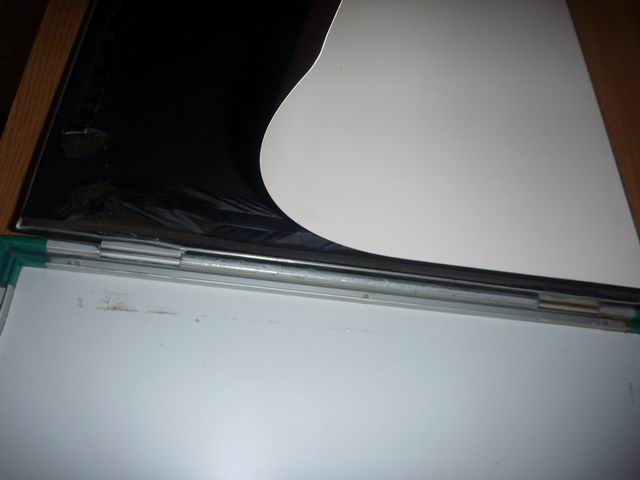
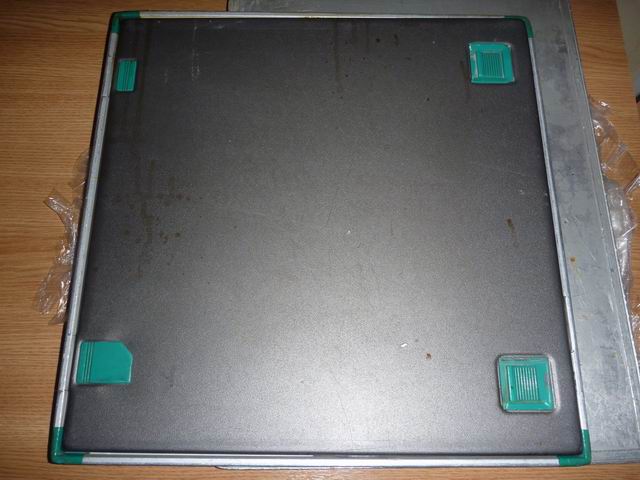
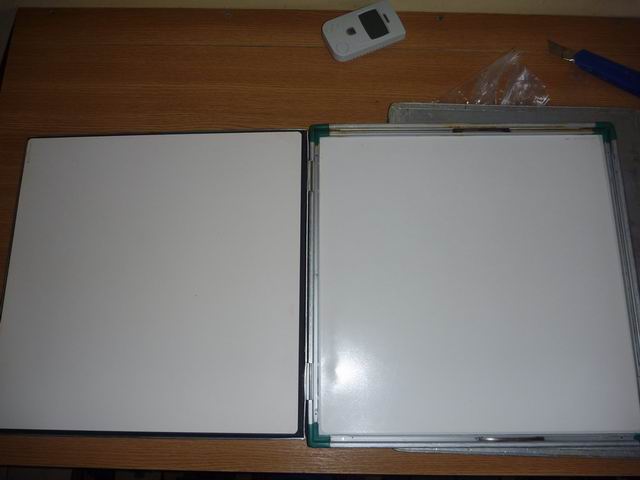
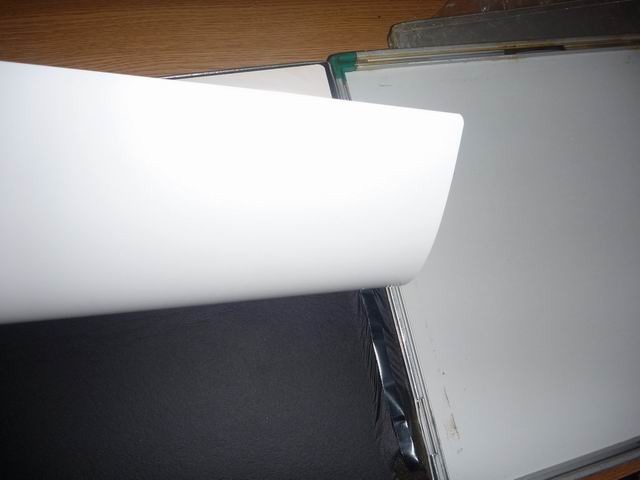
To remove the intensifying screen from a X-ray cassette is usually easy:
Some other phosphors commercially available, for use as X-ray screens, neutron detectors, alpha particle scintillators, etc, are:
* Gd2O2S:Tb (P43), green (peak at 545 nm), 1.5 ms decay to 10%, low afterglow, high X-ray absorption, for X-ray, neutrons and gamma
* Gd2O2S:Eu, red (627 nm), 850 µs decay, afterglow, high X-ray absorption, for X-ray, neutrons and gamma
* Gd2O2S:Pr, green (513 nm), 7 µs decay, no afterglow, high X-ray absorption, for X-ray, neutrons and gamma
* Gd2O2S:Pr,Ce,F, green (513 nm), 4 µs decay, no afterglow, high X-ray absorption, for X-ray, neutrons and gamma
* Y2O2S:Tb (P45), white (545 nm), 1.5 ms decay, low afterglow, for low-energy X-ray
* Y2O2S:Eu (P22R), red (627 nm), 850 µs decay, afterglow, for low-energy X-ray
* Y2O2S:Pr, white (513 nm), 7 µs decay, no afterglow, for low-energy X-ray
* Zn(0.5)Cd(0.4)S:Ag (HS), green (560 nm), 80 µs decay, afterglow, efficient but low-res X-ray
* Zn(0.4)Cd(0.6)S:Ag (HSr), red (630 nm), 80 µs decay, afterglow, efficient but low-res X-ray
* CdWO4, blue (475 nm), 28 µs decay, no afterglow, intensifying phosphor for X-ray and gamma
* CaWO4, blue (410 nm), 20 µs decay, no afterglow, intensifying phosphor for X-ray
* MgWO4, white (500 nm), 80 µs decay, no afterglow, intensifying phosphor
* Y2SiO5:Ce (P47), blue (400 nm), 120 ns decay, no afterglow, for electrons, suitable for photomultipliers
* YAlO3:Ce (YAP), blue (370 nm), 25 ns decay, no afterglow, for electrons, suitable for photomultipliers
* Y3Al5O12:Ce (YAG), green (550 nm), 70 ns decay, no afterglow, for electrons, suitable for photomultipliers
* Y3(Al,Ga)5O12:Ce (YGG), green (530 nm), 250 ns decay, low afterglow, for electrons, suitable for photomultipliers
* CdS:In, green (525 nm), <1 ns decay, no afterglow, ultrafast, for electrons * ZnO:Ga, blue (390 nm), <5 ns decay, no afterglow, ultrafast, for electrons * ZnO:Zn (P15), blue (495 nm), 8 µs decay, no afterglow, for low-energy electrons * (Zn,Cd)S:Cu,Al (P22G), green (565 nm), 35 µs decay, low afterglow, for electrons * ZnS:Cu,Al,Au (P22G), green (540 nm), 35 µs decay, low afterglow, for electrons * ZnCdS:Ag,Cu (P20), green (530 nm), 80 µs decay, low afterglow, for electrons * ZnS:Ag (P11), blue (455 nm), 80 µs decay, low afterglow, for alpha particles and electrons * anthracene, blue (447 nm), 32 ns decay, no afterglow, for alpha particles and electrons * plastic (EJ-212), blue (400 nm), 2.4 ns decay, no afterglow, for alpha particles and electrons * Zn2SiO4:Mn (P1), green (530 nm), 11 ms decay, low afterglow, for electrons * ZnS:Cu (GS), green (520 nm), decay in minutes, long afterglow, for X-rays * NaI:Tl, for X-ray, alpha, and electrons * CsI:Tl, green (545 nm), 5 µs decay, afterglow, for X-ray, alpha, and electrons * 6LiF/ZnS:Ag (ND), blue (455 nm), 80 µs decay, for thermal neutrons * 6LiF/ZnS:Cu,Al,Au (NDg), green (565 nm), 35 µs decay, for neutrons Other resources: http://en.wikipedia.org/wiki/Phosphor http://mcadams.posc.mu.edu/xray/taking/taking.htm